
Vikaros and Degand center their article around the idea that morality is an actively-constructed concept created through social norms, observations, and interactions. This involves a variety of cognitive abilities, including (but not limited to) socio-cognitive processing, cognitive dissonance, and schemas. Schemas allow the individual to organize and interpret scripts of situations, thus directing them towards the “proper” actions; this process is guided by skills gained from prior experiences (i.e. “social narratives” [Vikaros & Degand 2010]). Schemas are restructured and updated through the resolution of cognitive dissonance between an individual’s current beliefs and a situation that challenges such principles. In this way, morality based on schemas is not fixed and can be reorganized and adapted at any time. Vikaros and Degand argue that video games can play a large role in these reformations; through proper design and implementation, technology and video games can serve as a powerful vehicle for teaching morality to children. One of the most crucial aspects of such games is the incorporation of social access. As Vikaros and Degand cite multiple times, some of the most widespread (therefore influential) and effective shapers of morality and behavior contain social elements. Not only that, but players must also have “meaningful choices with observable consequences” (Vikaros & Degand 207); this means that there must not only be different paths to the game, but users must be able to pick their own paths and consequently understand the outcomes of those choices. Finally, Vikaros and Degand argue that the game must be properly tailored to a specific audience so that it is not only entertaining and engaging, but also teaches proper content and is “convincing” (Vikaros & Degand 208) in the ideas that it is teaching.
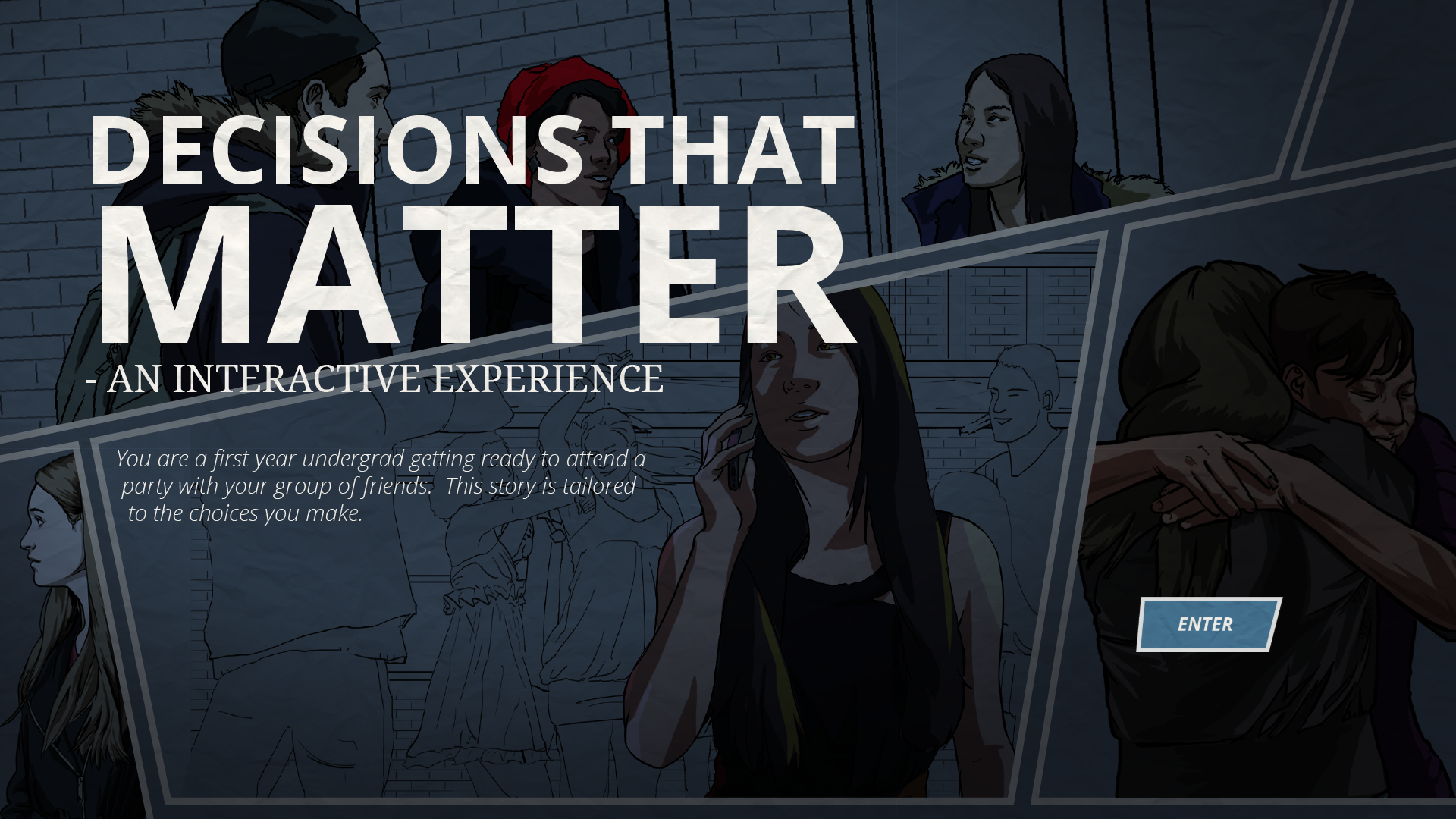
The interactive web comic “Decisions That Matter” jumps off of this idea of morality through video games. Centered around issues of sexual assault and college lifestyles, the comic places users in the middle of mock real-life situations with actual consequences. The user has a certain level of control over the situation, and can choose to intervene or stand by the sidelines. I think that there are two most important parts of this comic: the time and the end. First off, some decisions have time limits, where you only have a few seconds to make a decision. This mirrors real life seamlessly; in the heat of the moment, sometimes you really only have that moment to make a very real decision. This simulation calls on users’ abilities to make fast decisions, and then roll with the consequences (positive or negative) that go along with these choices. For me, however, the most impactful part was the end: Luke and Natalie transition into real people and the whole simulation becomes even more real. Suddenly, these are people who could easily be your friends or your family. These are very real people, just like the very real situations that the user just experienced. This type of explicit transferability to reality is imperative in both making people more aware of their decisions (and the implications of those decisions) as well as arming people with more skills to handle these types of situations.
In my experience, people talk to incoming college freshmen about sexual harassment, sexual assault, and safety, but it is often not “real” until you are actually in the situation. In the moment, it can be difficult to handle the situation properly if you do not have a toolbox of applicable skills and experience to guide you. We can talk about strategies and decision making until the cows come home, but it is a totally different world when you are actually living it. My father always talks about not knowing how you are going to respond in a situation until you are actually having to do it; you can attend trainings and read all of the books in the world, but there is a different part of you that activates in the moment. It is imperative that we train that portion of people, the “in the moment” portion, as much as we train the rational, cool-headed person. Unfortunately, however, this often does not happen, and our young adults are thrust into situations that they are grossly unprepared for. If we had more simulations like “Decisions That Matter”, simulations that force you to act just like you are forced to act in a real-life situation, I think that our young adults will be able to handle and diffuse these situations with greater success.
A question I have for the class is the following: do you think that we should have more simulations like “Decisions That Matter”? Should they all be about sexual harassment and sexual assault, or should we include others that cover topics like suicide, physical abuse, homelessness, and divorce? What are some implications, both positive and negative, of simulations like these?
 Emily's Blog
I do think that we should have more interactive video games like this. For me, when I played this game, I was very invested in the characters and was able to empathize with them. I think by using this interactive medium to highlight other problems such as suicide, homelessness, abuse, mental illness, and divorce that players can gain a deeper, more empathetic understanding of these problems. However, the negative implications of these types of interactive video games are that people could find the material to be too sensitive and feel uncomfortable or that the players could miss the point of the video game. For example, if a person was to go through the game “Decisions that Matter” and choose all the responses that led to everything being okay in the end, they may miss the message behind the game.
LikeLike
I think that there should be more simulations like “Decisions that Matter.” “Decisions that Matter” mainly focused on sexual harassment, and I think that other serious topics like suicide or mental health could be made into a simulation like “Decisions that Matter” to get its point across and to spread awareness. These simulations have positive effects because they create more awareness around this topic and teach the viewers a lesson in the end. However, these simulations could also have negative effects if the viewer does not pick up on the lesson. Potentially, this may do more harm than good.
LikeLike