Gina Bloom investigates the relationship and interaction between theater production, theater education, and technological interfaces. Bloom argues that the most important facet of teaching theater, and subsequently classic theater like Shakespeare, is the engagement and encouraged interaction of the learner and the theatrical process. This process, she continues, includes set design, character design, script writing, music scoring, and performance. Bloom contends that interactive, immersive “storytelling role-playing games” (2015, 118) are the most conducive platform to allow users to understand and take an active role in shaping the relationships between these theatrical elements. Not only that, but the virtual components of her game Play the Knave allow players to see their “performance mirrored ‘live’ on screen” (2015, 120) using real-time audio/visual mapping software. This software maps users’ active movements and recitations of Shakespeare’s lines onto the avatars that the users chose at the beginning of the experience. Screen and audio recording allow users to then download, share, and splice their performance with others. This means that the experiences of a few individuals are not limited to just those few; instead, virtual theater learning promotes communication and cooperation between individuals across the Web. This means that the players’ understandings of Shakespeare theater do not end when the simulation session ends: users are able to return to their performances and interpret the interactions between design, production, performance, and meaning. Bloom investigates this potential in the following three postulates:
- “users become and remain conscious of the relationship between interpretation and each of their production decisions” (2015, 121)
- “utilize performance for literary analysis” (2015, 121)
- “encourages experimentation and more extensive practice-based research” (2015, 121)
These capacities allow participants to actively engage and manipulate not only their own experiences, but also the interpretations of the scenes or entire works. This heightens the performers’ comprehensions of the texts, as they must “interpret Shakespeare’s text to find cues for movement” (PlayTheKnave.org). Not only that, but it also impacts the understandings of any viewers, both during the live performance and during later presentations of the recording. In both scenarios, the interpretations formed by all actors present are directly informed and shaped by the context and characteristics of each experience.
Bloom continues her arguments in her second article, forthcoming publication in Learning, Education & Games. In this piece, she creates cases for the implementation of Play the Knave throughout grade levels and into university, scaffolding the application of the game to the varying abilities of these age ranges. In elementary school, she cites the use of Play the Knave in teaching the impacts of grammar on comprehension and establishment of purpose or tone. In high school, Bloom explores how Play the Knave can be used to teach Romeo and Juliet, asking students to identify impactful lines, diction, or syntax and then translating these elements into physical movements. Through planning and performance, students grasp the characters’ states of mind and Shakespeare’s rhetorical choices. At the university level, students can manipulate and comment on the impacts of set design, character gender, voice tone and inflection, and movements all have an impact on the interpretations and meanings of various Shakespearean scenes.
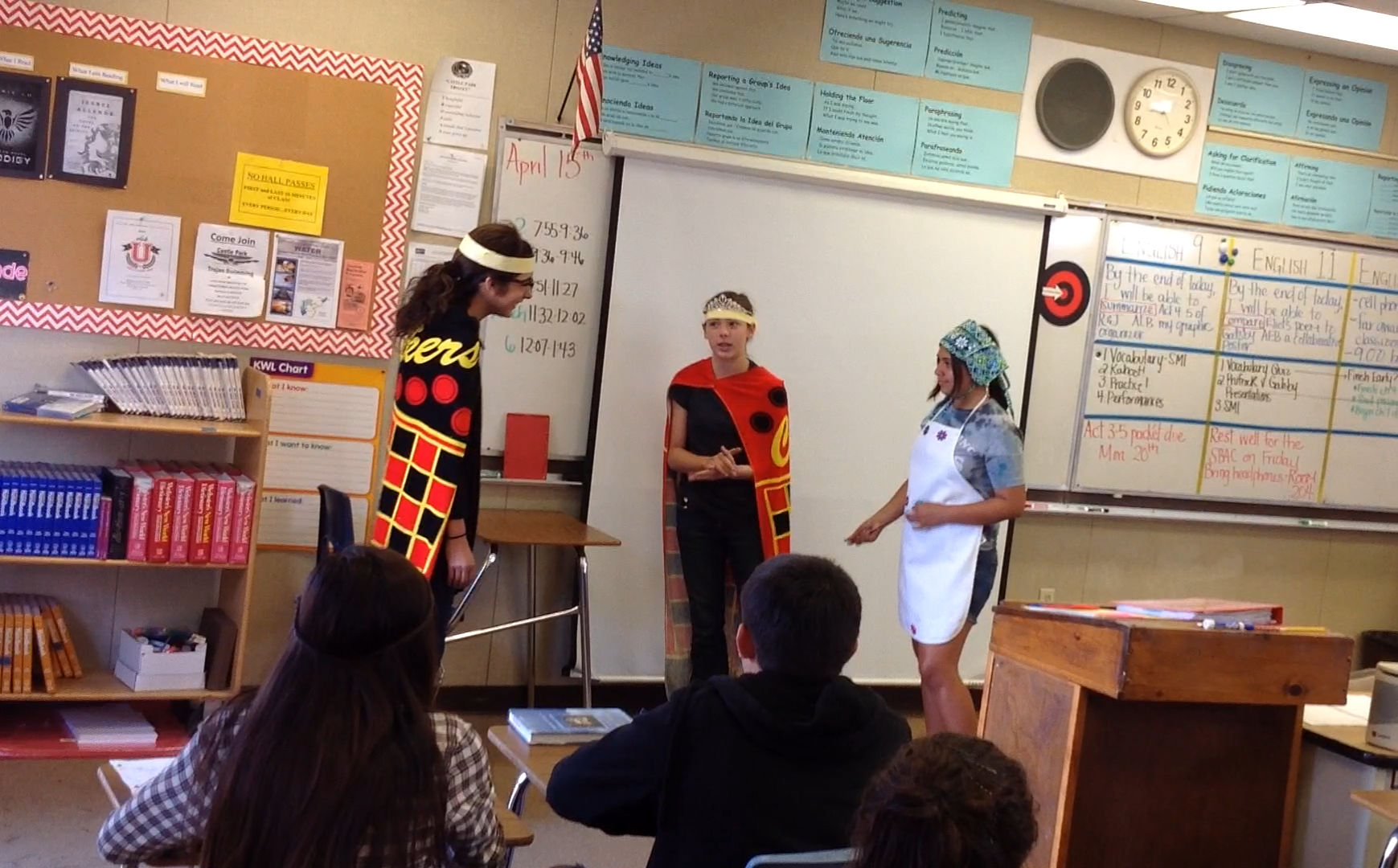
My Shakespearean experiences were not, unfortunately, this engaging. I read Romeo and Juliet three times between my 7th, 8th, and 9th grade years. Each year was the same: read a certain act, talk about Shakespeare’s emotive diction, syntax, purposes, the representations of the characters, and so on. The most interaction that I experienced with Shakespeare was the third (and thankfully final) time I read Romeo and Juliet in 9th grade. My teacher was a first-year English teacher right out of the credentialing program, so she was full of new ideas and we were her guinea pigs. This turned out to be quite captivating: when we were about halfway through Romeo and Juliet, she put the class into small groups and assigned us each a scene. We then translated lines from the play into modern-day approachable language, memorized these lines, created costumes and props, and acted out our scenes in front of the class. Afterwards, we had to write a reflection about why we chose the specific costume designs, props, and scene elements (if applicable), and how these aspects of our performance contributed to the mood of our scenes. Not only that, but she also asked the audience to interpret what they thought the most important and impactful portion of our performance was; it was fascinating watching and discussing the congruence or dissonance between what the performers were trying to create and what the audience actually interpreted. Though this did not involve technology (outside of the iPad that my teacher used to film the presentations), I remember the most about Romeo and Juliet from this presentation. I was also the most engaged and had the most fun with this style of learning; as we have seen throughout the quarter, capturing the students effectively allow the teacher to teach content to a deeper and more impactful level.
A question I would pose to the class would be the following: were you ever able to engage with your assigned literary texts like Play the Knave is trying to do? If so, did you experience this with other Shakespearean works, or with a different author? How did this impact your comprehension of the text? If you did not, do you think that having this sort of interactive experience would have been helpful? Which of the texts that you studied would you apply this type of supplementation?
References:
Bloom, G. (2015). Videogame Shakespeare: Enskilling Audiences through Theater-Making Games. In Siemon, J. R. & Henderson, D. E. (Eds.), Shakespeare Studies (vol. 43, pp. 114-127). Plainsboro, NJ: Fairleigh Dickinson University Press, an Associated University Press.
Bloom, G. (forthcoming). Play the Knave. In Learning, Education & Games: 100 Games to Use in the Classroom & Beyond (vol. 3). Pittsburg, PA: ETC Press, Carnegie Mellon.
PlayTheKnave.org. (n.d.). Pedagogy Report [Webpage]. Retrieved from
https://playtheknave.org/classrooms/pedagogy-report/.
Schooling, D. [Davis ModLab]. (2017, March 02). Play the Knave trailer [Video file]. Retrieved from https://www.youtube.com/watch?time_continue=89&v=jR0JhoQWQjc. (Cover image)
 Emily's Blog
Hi Emily,
I appreciate how thorough both your reflection post and FoE post were for Tuesday’s class; I also think it’s super cool that you have and were willing to share a photo from your own Shakespeare experiences in school. To answer the questions you posed, I did not ever engage with assigned literary texts in the same way that Play the Knave engages one with Shakespeare, especially when considering the technological and gaming elements, however I did also have a performative unit on Shakespeare in high school – I’m imagining it must be some sort of high school language arts standard if many of us had similar experiences. For my freshman and sophomore English classes we would all break into groups and choose to either do a film or a skit of one scene from a play. I chose to do a skit in my freshman year and a film in my sophomore year and felt that the process helped me understand and consider the text differently than if I were simply reading it in my head or even out loud. In trying to figure out how I would put the text into action (and knowing that I had to do so in front of the class), I learned more about the differences between drama and other less performative literary texts and grappled with finding the deeper meanings of complicated older English, simultaneously trying to modernize it to show how Shakespeare’s works are accessible and interesting.
LikeLike