Leah Buechley addresses the homogeny and elevated status of individuals who take part in a specific opportunity. Her focus was the magazine company Make; an engineering and technological innovation publication that encourages readers to create and experiment with new technological advances. Make hosts “Makers Fair” where any and all readers can showcase their work created through the projects developed and published in the magazine. As Buechley discusses, this sounds absolutely wonderful and refreshing; that is, until you study the demographic producing, depicting, and consuming the brand. Throughout nine years of business, with four publications per year, Make featured men or boys on the front cover 85% of the time, all of whom were Caucasian or Asian (Buechley). The editorial team was 87% male, again with no people of “underrepresented” minority groups (Buechley). The consumers of Make are similarly homogenous: 80% male, 97% college educated, median age of 44, and median income of $106,000 per year (Buechley). This income level, Buechley cites, is more than 82% of American households and more than 96% of Individual Americans. This means that not only are chronically-underrepresented groups not depicted or included in the production of Make, but they are also not consumers. Subsequently, these groups and individuals are habitually excluded from positive, innovative communities like the one Make creates; once again, elevating a limited cohort of the population while simultaneously suppressing and marginalizing the collective majority.
Buechley comments that Make “promises” inclusion, ability, space for innovation and revolution, yet the delivery and audience show the repetition and perpetuation of gender, race, and economic discrepancies. Instead of challenging the norm and creating a new space, Make fell back into the elitist, homogenous gear that power computer science, technology, and other related fields of study. Not only that, but the overwhelming economic elevation exhibited by Make’s consumers continue these gaps: tech companies are funneling money into projects like Make, but the beneficiaries of these funds are individuals who are already primarily affluent. Buechley culminates all of these factors and realities into a single outcome: Make touts that “every child is a maker”, but what this ultimately means is that every child ought to aspire to be like a rich, white male. Buechley argues that there is so much that is not being highlighted, so much that exists that is excluded from this kind of mainstream promotion. Consequently, this serves to illegitimatize these forms of “making” in favor of elevating the current, comfortable, marginalizing systems. Instead of including the creations and innovations of everyone, like communities of low-riders and hip-hop scratchers, these expressions are diminished. In this, these people are lessened as well.
In keeping with this inclusion of the backgrounds and strengths of every community, Gloria Ladson-Billings revisits her idea of culturally relevant pedagogy, commenting on its impacts, transformations, and shortcomings. She addresses the fact that there has been an increase in teachers attempting to revamp their pedagogical approaches and strategies in order to incorporate increased cultural aspects; however, this has been somewhat unsuccessful and actually ventured against Ladson-Billings’ original ideas. Ladson-Billings argues that the idea or practice of “adding some books about people of color, having a classroom Kwanzaa celebration, or posting ‘diverse’ images makes one ‘culturally relevant’ seem to be what the pedagogy has been reduced to” (82). Due to these shifts, and the natural changes in education across time, Ladson-Billings proposes a secondary pedagogical approach: “culturally-sustaining pedagogy”. Through this tier of pedagogy, teachers must not only effectively capture students through cultural relevance, but also maintain the application and importance to the student throughout their curricula. This also means that the teacher must adapt their approaches to the changing “youth climate”: the forces that impact the creation of youth identities both on a local and global community level. In short, it is not enough to simply address culture, but it must become a continuous, guiding, and adaptable trend in the classroom and lessons.
Ladson-Billings takes this a step further and discusses a rising third tier of pedagogy: “culturally-revitalizing pedagogy”. Using research and ideas from McCarty and Lee, Ladson-Billings addresses the idea that classrooms can be arenas for the extraction and rejuvenation of extinct or diminishing cultures and languages. She posits that teachers can create “plurilingual educational spaces” that center around “reclaiming and restoring [students’] cultures” (82-83). Overall, Ladson-Billings focuses on the necessity of classrooms and properly-implemented, culturally-centered pedagogy to be adaptable, maintained across lessons and across subjects, as well as spaces for the explorations and reviving of disappearing cultures.
In keeping with this student- and culture-centered pedagogy, Maisha Winn addresses the need for the consideration, inclusion, and reintegration of incarcerated, expelled, or otherwise alienated students into the classroom. Winn argues that students do not need to be convicted felons in order to need help with reintegration into society; anyone who “[shares] an ethos of confinement; that is, they routinely encountered physical isolation (e.g., referrals, suspensions, and expulsions) as well as symbolic alienation (e.g., low expectations and labels such as “at risk”) throughout their academic trajectories” (126) should be included in restorative practices. Winn highlights the use of circles to spawn and encourage discussion, storytelling, critical listening, and critical thinking skills among participants. These participants, she argues, are not limited to marginalized students; teachers, community members, successful youth, parents, and COs all receive transformative experiences when they participate in “peacemaking” circles. In these circles, representations are challenged, purposes are expressed, emotions are shared, trust is exchanged, and empathies are created through mutual listening and healing. All participants are able to “suspend judgement and ask broader questions” (131) in order to gain a better understanding of where everyone is coming from and what each person needs. As Winn closes her paper, the main goal is to “reintegrate youth back into classroom communities through restorative practices” (133).
Just as I was leaving high school, talks of restorative practices began to circulate. The idea is for teachers to take 10, 15, 20 minutes of their class, gather everyone together, and talk about anything but content. Even beyond that, the teachers and administration are discussing designating an entire period, similar to a daily advisory, within which teachers would receive a new batch of students to connect with. This allows the students to participate in a small-group setting, while simultaneously connecting with a mentor on campus who is not one of their regular teachers. The overwhelming majority of my high school population is chronically mislabeled, misinterpreted, and mistaken as “at-risk” and “underperforming” students who exist on the periphery. Many of these students share common struggles, home lives, family dynamics, racial dynamics, and forms of discrimination that they internalize and cannot heal through; having a safe space to discuss, understand, and restore is imperative in cultivating their personal as well as academic successes.
When my father worked for the juvenile court schools, he witnessed the tremendous impact that group therapy had on the students; the ability for everyone to sit down and talk through what they had experienced (or were currently experiencing) not only helped the students understand one another, but also allowed them to address their own struggles. For often the first time, students saw that adults believed in them, wanted to understand and help them; students saw that they were not alone and that they could turn around to become something great.
This kind of holistic education is not limited to the secondary or criminal education systems; when I work in elementary classrooms, the rise of so-called “social-emotional learning”, or “SEL”, is pervasive. Teachers spend the first 10 to 20 minutes of their class sitting with their students and using a variety of techniques to ground, focus, listen to, and welcome students into the day. Instead of centering around healing, SEL attempts to teach young children how to balance and hone their emotions, how to constructively and positively interact with one another, and how to communicate both how they feel as well as how others make them feel. In a classroom community, properly-implemented SEL creates a climate where students are not taught to forget or suppress how they feel, but instead identify, process through, and resolve their emotions.
A question I would like to pose to the class is the following: if you were running a restorative circle in a high school classroom, what would be your first question or concept you would focus on? What about in a court or other judicial-system school? What about in an elementary school?
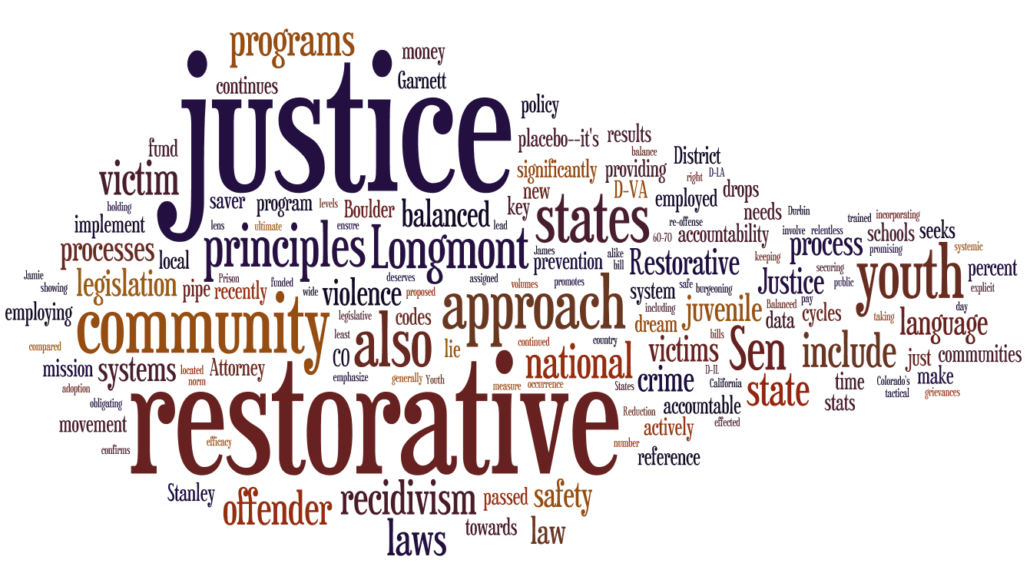
Cover Image Credit: Pavelka, S. & Leach, M. R. (2014). The Political Rise of Restorative Justice [PNG]. Retrieved from https://peacealliance.org/the-political-rise-of-restorative-justice/.
 Emily's Blog