
Technology: a facet of our society that now seems to appear at every turn, in every room, and in almost every hand. The exponential increase of computers, tablets, smartphones, and the Internet has absolutely revolutionized the way that our society thinks, functions, communicates, and ultimately learns. Unfortunately, our school systems are seemingly stuck in a past, traditional rut where students are anchored to archaic textbooks, “classic” literature, and conventional teaching strategies. Students have access to the entire world at their literal fingertips, yet our school system seems to outlaw and skirt this ability at every turn. As the Collins and Halverson article investigates, technology is rapidly shifting how students learn outside of school, and if the current school structure does not mold and adapt, it is in danger of being left behind. Education through technology takes the teacher off of the stage as the authoritative, all-knowing professor and instead empowered and emboldens the students to learn through their own explorations. Collins and Halverson demonstrate that technology allows students the opportunity to learn actively, across cultures, across content areas, across modalities, by interaction, through experimentation, and at their own pace.
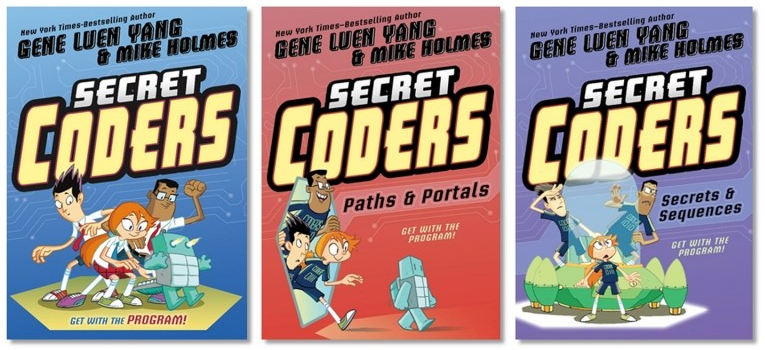
Gene Luen Yang’s TED Talk builds on this concept: through a series of circumstances, demands, and adaptations of his teaching style, he found that teaching his students mathematics through comics allowed them to engage with the content at their own pace and following their own interests. His students both learned more and enjoyed their learning more than they did in his conventional teaching strategies. Yang argues that the misconceptions surrounding comics are simply that: misinformed, misguided, misconceptions that have poisoned the use of comics in schools for more than 60 years. Yang contends against these restrictions, citing various examples among his own colleagues where comics are used in a variety of settings and applications, but maintain similar successes. Yang has also authored multiple comic and graphic novels, including Secret Coders: Book One. 88 pages of black, white, gray, and green graphics tell a story of a pair of middle schoolers who attend an “odd” school. Using elements of mystery, puzzles, and harnessing the awkward nature that so often surrounds middle school, Yang and his co-author Mike Holmes actually teach binary and coding to young audiences. The highlighted pair of the story, Hopper and Eni, use binary-coded birds and a voice-programmed robot turtle to explore aspects of their secretive school. Once again, Yang incorporates learning into student-driven experiences that allow his audiences to engage independently and at their own paces with the material.
Hall and Lucal also address the advantages of using comics in the classroom to teach sociological concepts. Unlike Yang, they do not create their own comics; instead, they use existing comics to teach larger concepts like gender, equality, violence, cultural values, prejudice, and discrimination. By using a familiar base such as superheroes, Hall and Lucal discuss how they are then able to dissect and discuss more complex themes with the students. This also allows students to connect what they observe in the “real world” to what they are reading in the comic books, as well as how the two influence each other. These types of activities give students the jargon to discuss these phenomena while simultaneously providing an approachable foundation to build upon. Not only that, but the students are actively engaged in the material since it is, yet again, interactive and follows their interests. Just as Collins, Halverson, and Yang discussed: if the students are captured by the content, you can expand and teach them almost anything.
The part of this specific set of texts that excited me the most was actually having the opportunity to read the Secret Coders book. For as long as I can remember, my cousins, friends, and I have been interested in “spies”, mysterious “puzzles”, and encoded messages. Growing up, we did not have access to a lot of materials that fostered these interests; all of the girls our age expected us to play with dolls and glitter and watch YouTube makeup videos. This was not a “bad” way to spend our time, but it was the opposite of what we were actually interested in: building booby-trapped secret lairs, communicating in code, creating and inventing things that would spy on our “enemies”. We crafted our own simplistic ciphers from our own imaginations, because there were very few toys or resources that promoted what we were interested in. Fast forward almost ten years, my interest in codes still exists; I am a junior in the IB Diploma Programme and I am writing my internal assessment in mathematics on how we can use modular arithmetic and the Chinese Remainder Theorem to create and break ciphers. Fast forward again to present day: I am sitting in a college class, reading this book that is geared for second to fifth graders. Before I read this novel, I admittedly had no clue how binary worked and innately thought it was a difficult computer language that I would never understand. Now, my wheels are turning. I start imagining and drawing out how binary could be converted into a number cipher that could then be transduced onto an alphabet cipher to create a dual-encoded message. Here is an example:

Example: Encipher “Emily’s Blog”
E m i l y ’ s B l o g
5 13 9 12 25 31 19 l 2 12 15 7
o-o oo-o o–o oo– oo–o ooooo o–oo l o- oo– oooo ooo
If, as a college student with very little coding experience, I can learn this, I can imagine this, I am ecstatic to see what impacts this has on our current children. My six-year-old cousin learns math through abstract tablet games and her idea of “family game night” is playing Code and Go Robot Mouse. Her mind already works differently than mine, and resources like Secret Coders await her as she grows older. This excites me beyond description because this again shows the impact that comics and other “unconventional” teaching strategies can have in the classroom, and how much children can truly learn if they are engaged.
From this, I would pose the following question to my classmates: how different would your childhood have been if you had access to resources like Secret Coders? Would you have played differently, imagined differently, or aspired to be something different had your teachers incorporated more comics or non-traditional materials into their classrooms?
 Emily's Blog
If I had read Secret Coders, I might have been more interested in coding and computer science. I do think the books you read as a child really influence you, which I think happened to me with my reading. I grew up reading a lot of historical fiction like the Dear America series and am still interested in history, especially from the perspective of women. I also read a ton of books about animals like the Pony Pal series, Charlotte’s Web, and Because of Winn-Dixie, and have a strong connection to and love of animals still. Being a girl also probably played a part in the books that I was exposed to. I didn’t know any girls or adult women interested in coding/computer science/technology in general, so maybe I just thought it wasn’t a “girl” thing. I think the fact that one of the main characters in Secret Coders is a girl would have made me more interested in coding too. I probably would have thought it was totally normal for girls to code and felt more comfortable pursuing that interest.
LikeLike
I discovered the world of coding the summer before my senior year of high school. After doing a brief course online I decided I was more than ready for AP Computer Science and decided to brave the class without the fulfilling the necessary requirements. As bold as this decision was, everything worked out in the end. I was able to complete my final project of creating a working form of the game Battleship from a blank screen to a functional program which I am still very proud of to this day.
During college application season I started considering Computer Science as a major regardless of my brief and unrealistic exposure. Unfortunately I was nowhere near qualified to study this subject, but I am still happy where I am today.
That being said, if I had grown up with books like Secret Coders when I was a little girl, I have no doubt that I would have gotten into coding much earlier in life. I took to the content very quickly and easily and I had a genuine interest in all of it. It is also a very lucrative and in-demand field to go into, so perhaps that would have been a smarter choice for my future as opposed to the animal focused track I am currently on.
I am not ungrateful for where I ended up or even what I’m currently studying in college because it still feels right. However, I am extremely appreciative of the resources that are out these days that draw young girls into the field of STEM and introduce them to male dominated subjects, paving the way to a brighter future for all of us.
LikeLike